Stories in Flight
watercolour art – mural – waves of migration – hən̓q̓əmin̓əm̓ glossary – gratitude – sources
Created by Paula Gomez Villalba | Feb 2026
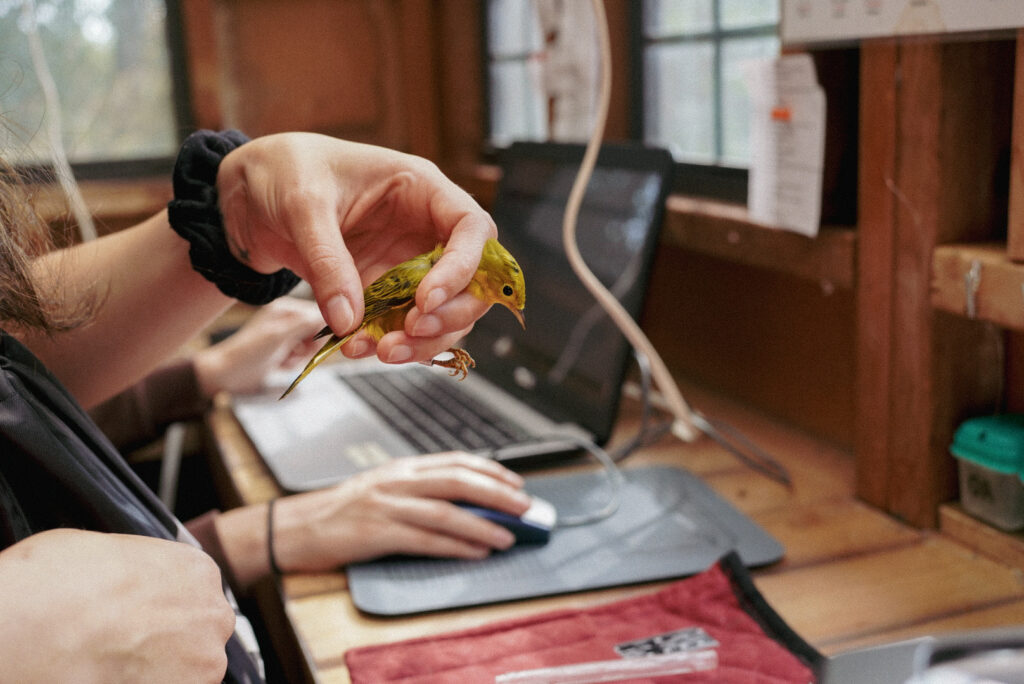
Stories in Flight was born out of many sunrises filled with birdsong, hours walking across the sandy soil on Iona Island (xʷəyeyət in hən̓q̓əmin̓əm̓), and animated conversations about what we can see here as the seasons change.
Listen to a morning in May at Iona Island:
Millions of migrating birds come here to rest, recharge, and breed. It’s where the Fraser River meets the Pacific Ocean. The Iona Island Bird Observatory (IIBO) sits in the forested part of the park, a banding station run by the non-profit WildResearch that offers opportunities to study birds up close and take part in hands-on science. Since I began volunteering at the Iona Island Bird Observatory (IIBO) in 2019, the people, birds, and my other experiences have shaped my approach to conservation – one that is grounded in people’s connections to nature and a deep respect for the land.
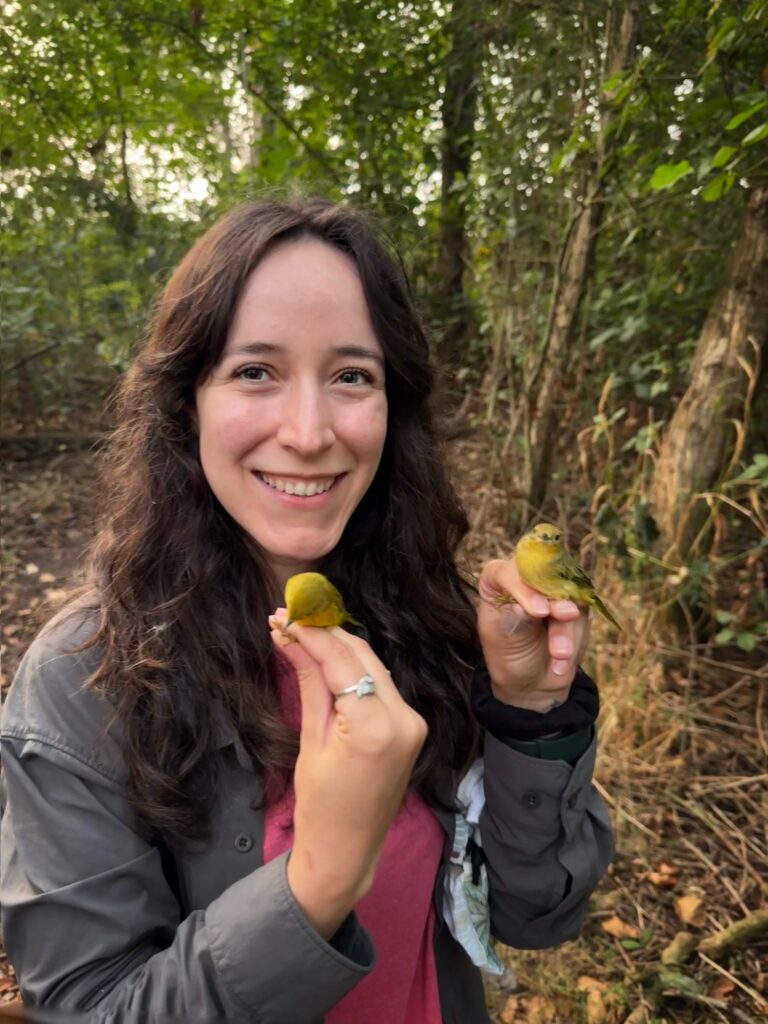
I am a biologist, science communicator, and Latina settler who grew up on Muisca traditional territory in Colombia and on xʷməθkʷəy̓əm (Musqueam) territory in Richmond, B.C. Both my home and the IIBO are based on Musqueam territory, and I am incredibly grateful for their stewardship across millennia and history standing up for their land and values.
This project reflects a desire to create space and make the IIBO more accessible, inclusive, and fun. The outdoors is for everyone. Stories in Flight brings together science, art, and land connection to share stories of the estuary, plants, and birds in a good way weaving in Musqueam resources.
From the beginning, I knew it was essential to reach out to Musqueam’s Environmental Stewardship Department – for consent, guidance, and to find meaningful ways to include hən̓q̓əmin̓əm̓ words to highlight the connection between language, history, and land. My hope is that these stories invite you to deepen your relationships with the land, water, and living beings, rooting them in respect.
Map by Paula Gomez Villalba with icons by Malkolm Boothroyd.
Colour carries stories of the estuary through watercolour art created by Julia Avison, a pilot and artist originally from Ontario, who grew up exploring Canada’s wilderness through backpacking and camping. The natural beauty of the Pacific Northwest sparked her passion for painting and sharing her love of nature through traditional ink and watercolor paint techniques.
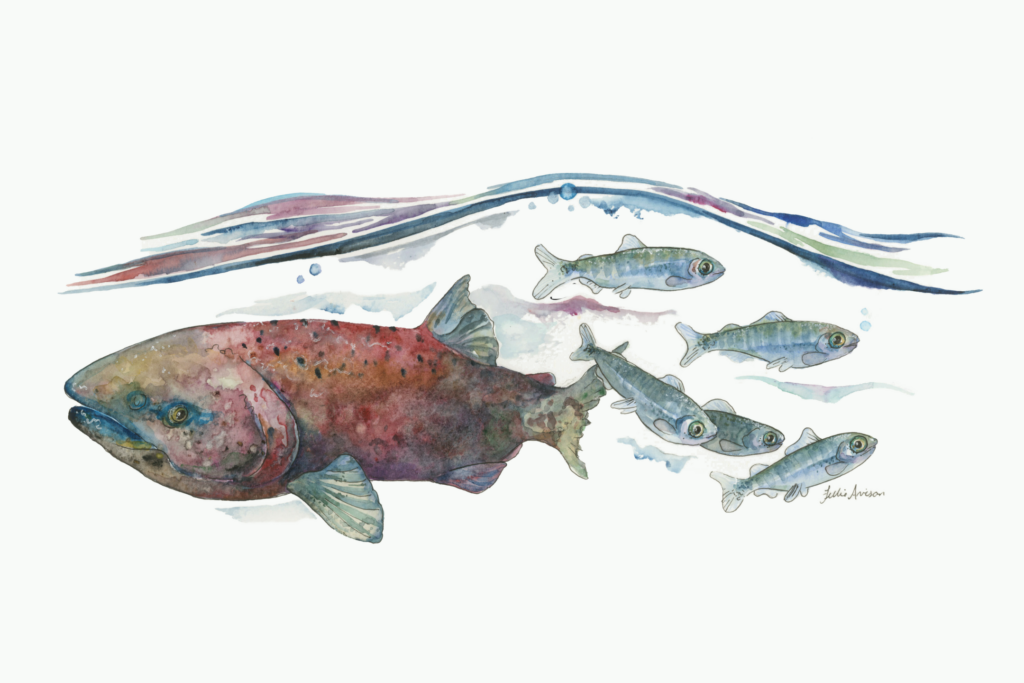
Chinook swim up the Fraser River to spawn, while young smolts move downstream to the estuary, adapting to saltwater.
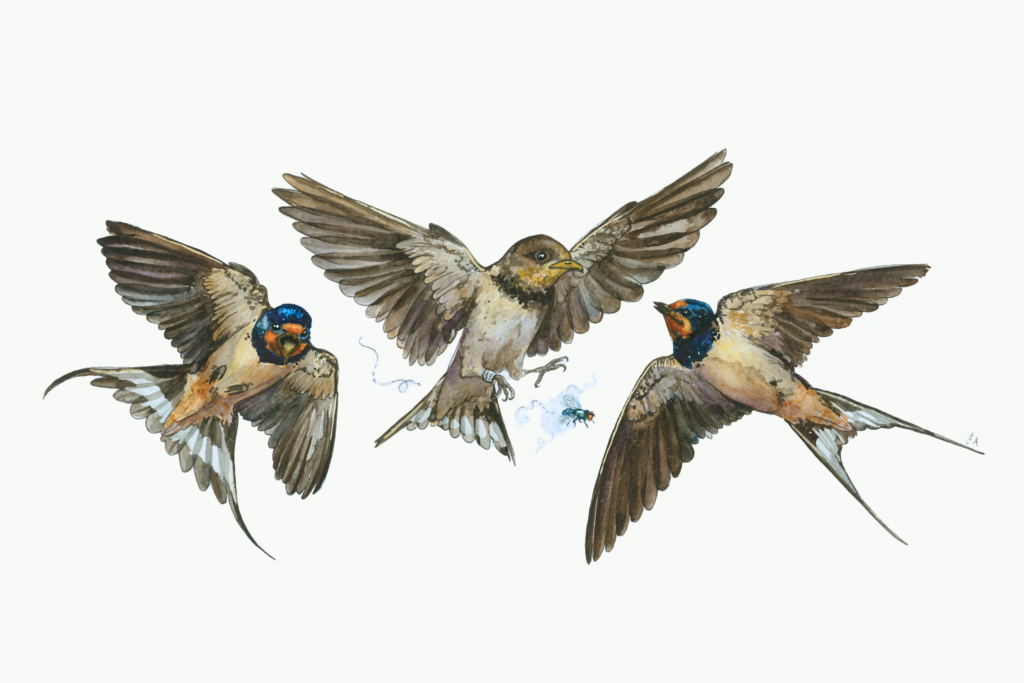
A young (middle) Barn Swallow and two adults dive and twist through the air to catch and eat insects mid-flight.
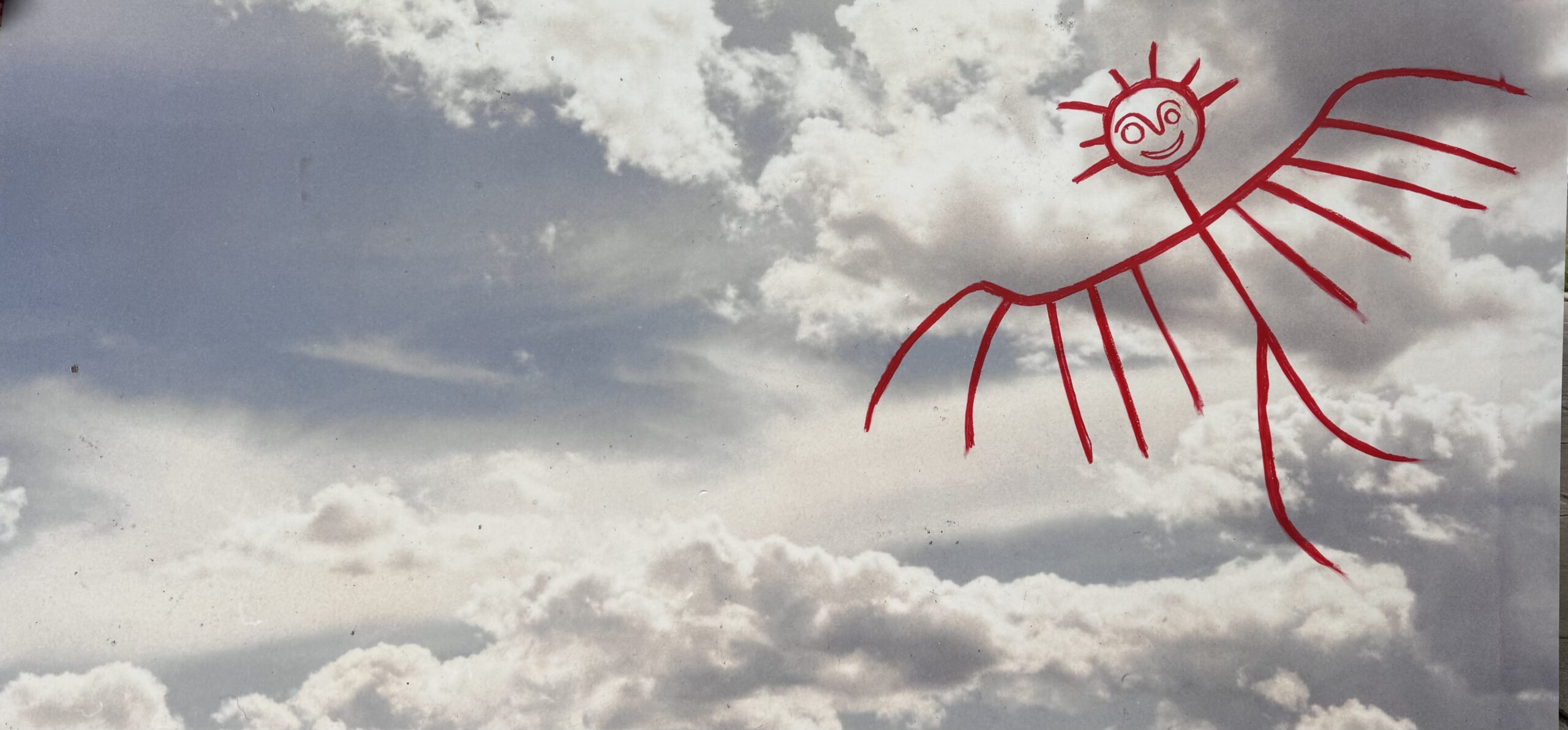
Art and conservation will also come together inside the banding hut through ʔiyəs, a mural created by Manuel Axel Strain.
Manuel is an artist from the lands and waters of the xʷməθkʷəyəm (Musqueam), Simpcw, and Syilx peoples. They drew on pre-classical Coast Salish visual languages to create a bird form that moves across a photographic field, mixing new and old visual cultures.
Coast Salish creation stories often highlight that when humans were created, we descended from the sky and the clouds, and then χe:l̕s the transformer, turned different people into animals, rocks, and plants. The bird form embodies this theme of transformation. ʔiyəs is both documentation and relational storytelling, reflecting the Iona Island Bird Observatory’s monitoring work while honouring Indigenous understandings of birds as relatives and messengers.

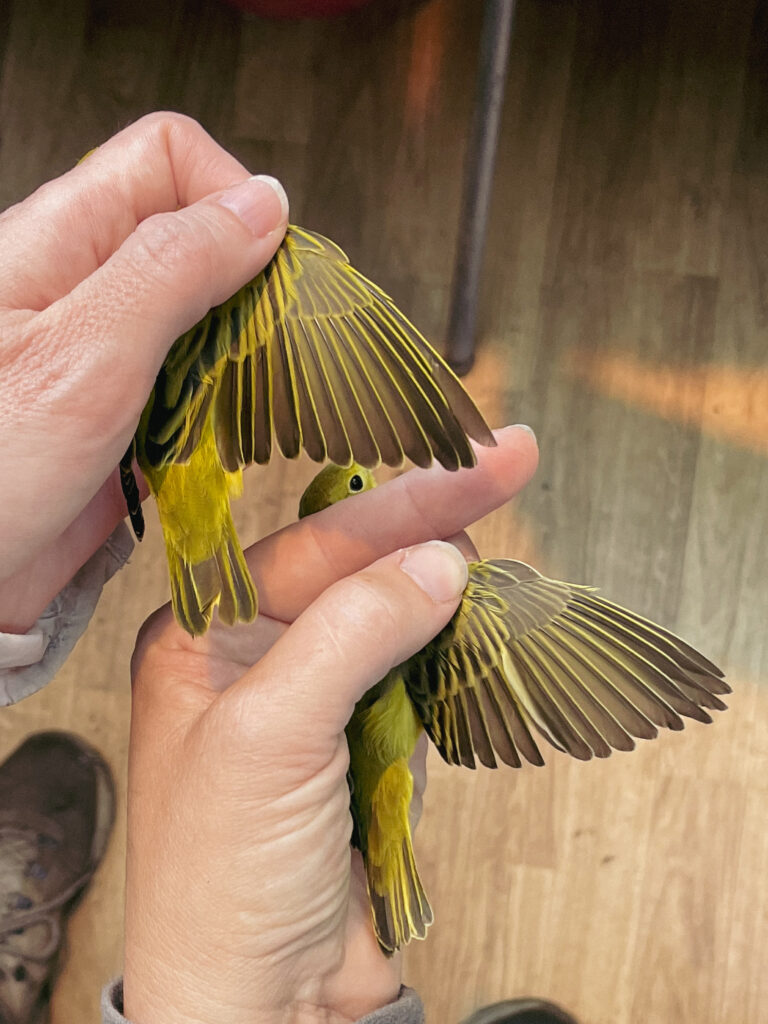
While we can tell stories through art and words, at the IIBO the birds share their stories with us through their feathers and presence. We can look at the growth patterns on a bird’s wing and body to understand their age and whether the feathers are worn from flying south last fall and back.
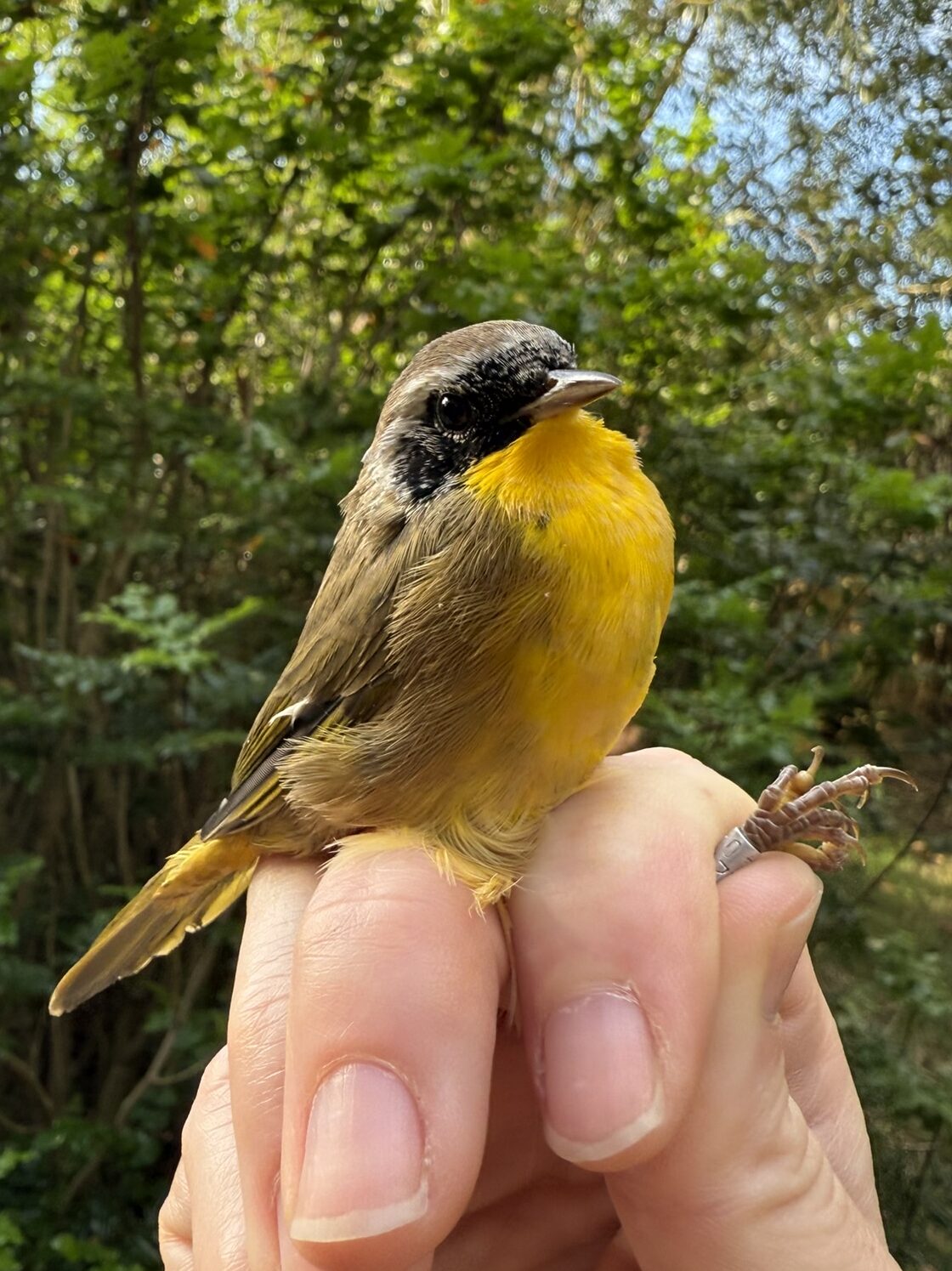
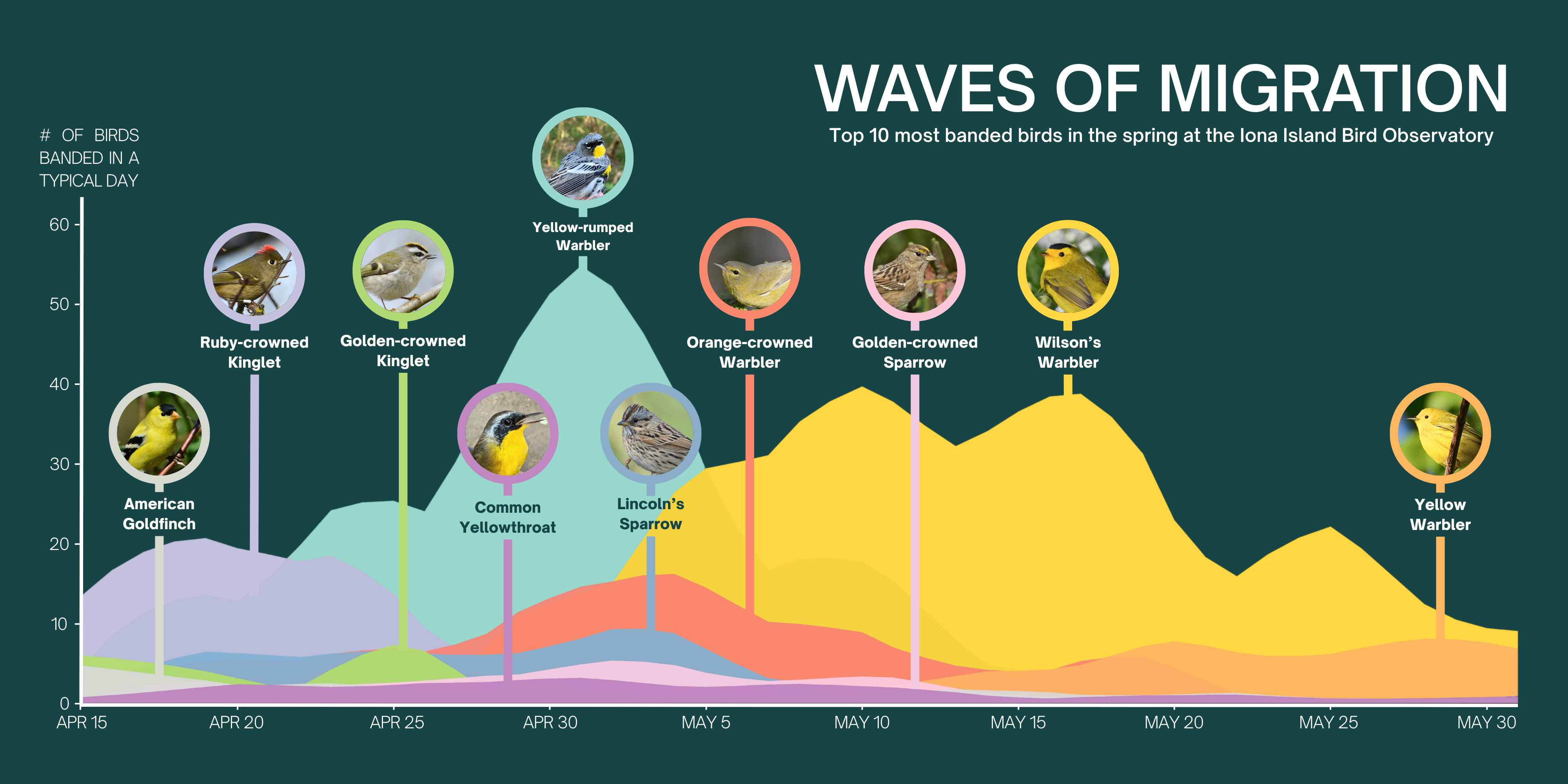
A bird’s presence here is shaped in part by the emergence of the plants and insects they rely on, and the length of their journey. They arrive at Iona Island not all at once, but in waves of migration. There’s rhythm in their flights. These waves of migration are reflected in the numbers of the 10 most frequently banded species throughout the spring.
Learn more about the science and stories behind waves of migration here.
You can view the art and explore these stories through interpretive signage at the Iona Island Bird Observatory when spring migration begins. Take a walk around the banding station too, and learn about native plants and their connection to birds and people.
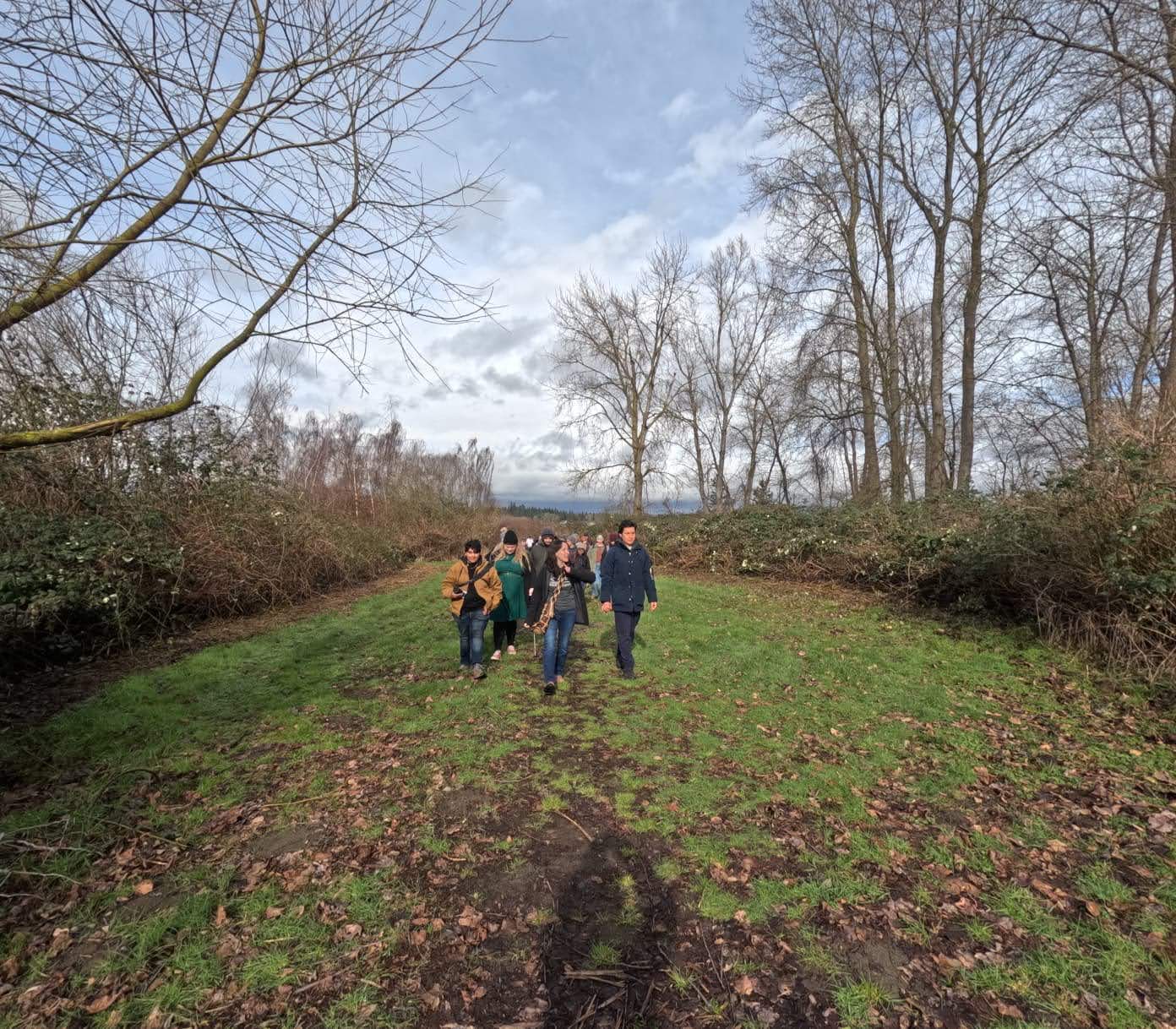
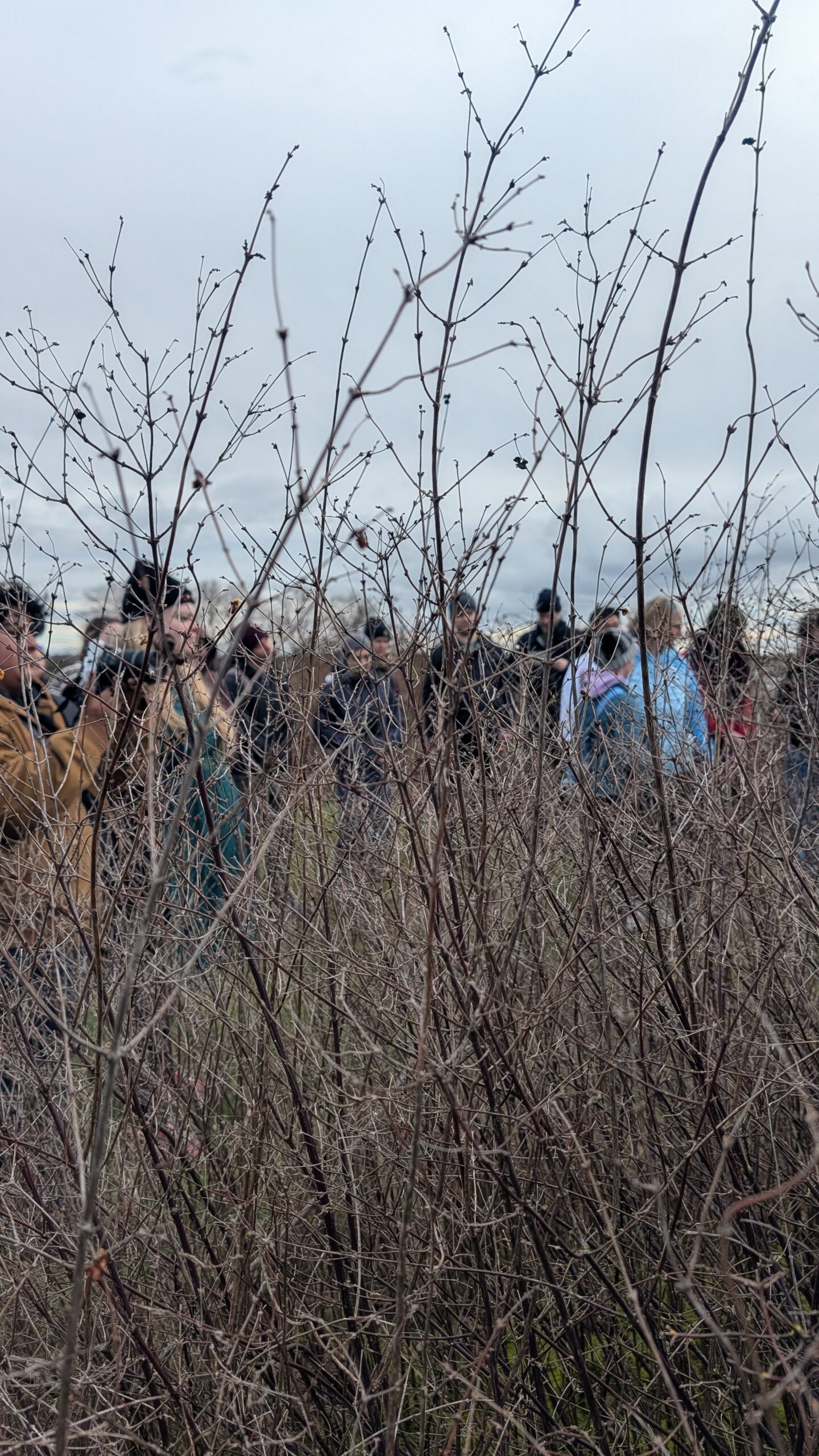
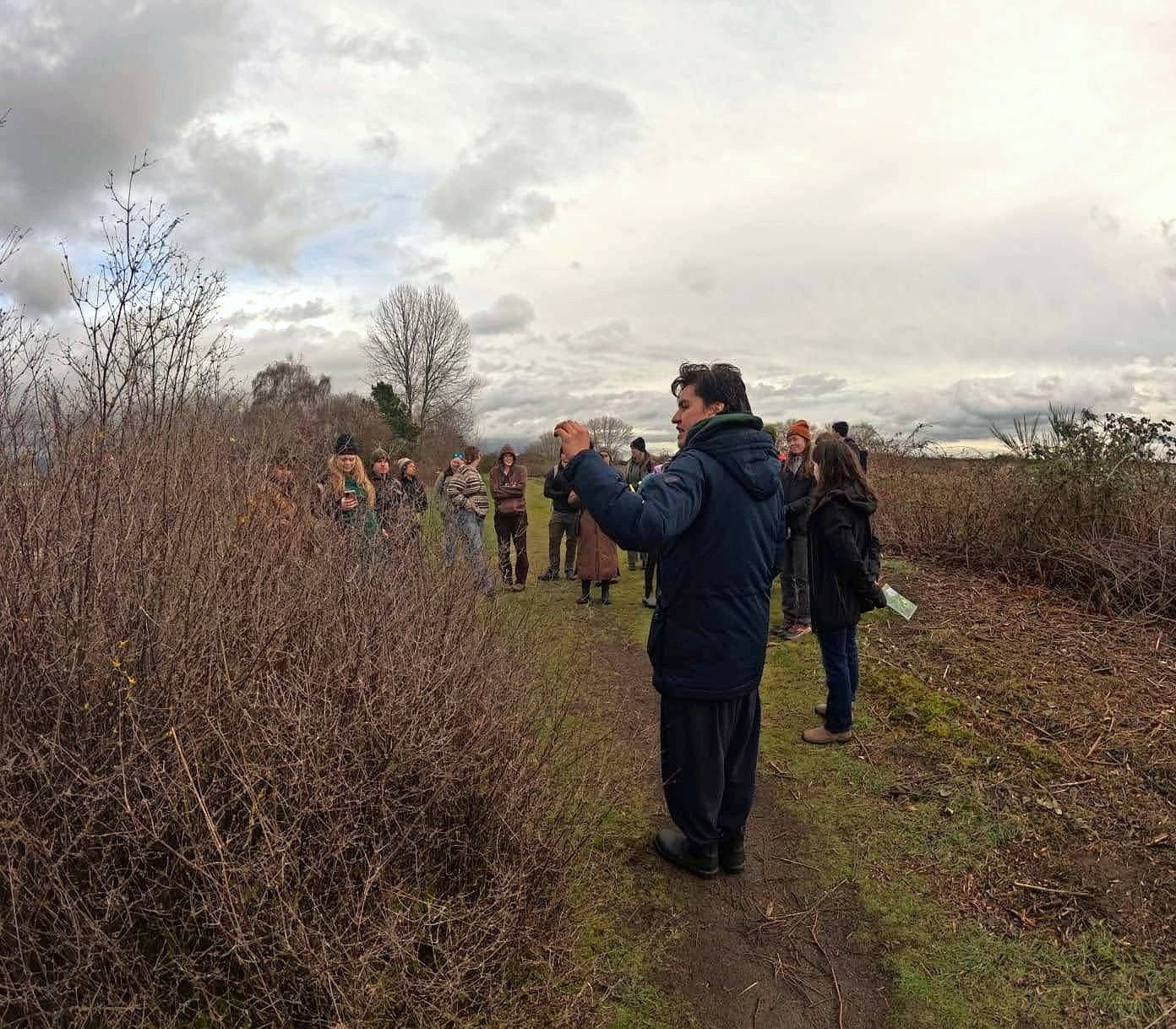
Stories in Flight Community Event, where Manuel led a plant walk and folks got an inside look at the interpretive signage.
On the main sign, there’s a section on Walking with Respect that says, “By listening to Musqueam teachings, supporting restoration, and treading lightly, we can honour both the land and the people who hold its stories.” Please take time to explore xʷməθkʷəy̓əm: qʷi:l̕qʷəl̕ ʔə kʷθə snəw̓eyəɬ ct—Musqueam: giving information about our Teachings. There are beautiful interviews, stories about impact on the Fraser River, important histories, and more. It is our responsibility to learn (and unlearn).
hən̓q̓əmin̓əm̓ glossary
Learn about the history and pronunciation of Musqueam’s traditional language, hən̓q̓əmin̓əm̓.
- xʷməθkʷəy̓əm – Musqueam
- xʷəyeyət – Iona Island
- stal̕əw̓ – River
- ʔiyəs – Happy (title of Manuel’s mural)
*More to come in the spring
acknowledgments
I am incredibly thankful to everyone who supported Stories in Flight and helped bring to life ideas that had been swimming around in my head for years.
Julia Avison and Manuel Axel Strain, your creativity and unique styles really elevated this project, and will help people of all ages connect to nature through art into the future.
Thank you to Shaan Aroeste and Sarah Skapski at Musqueam; Shaye O’Donnel and Amy Charles at Ocean Wise; Melanie Blendell, Alison Pocock, and Jennifer Swanston at Metro Vancouver Parks; and of course WildResearch’s Vik Juciute, Vinci Au, and Angela Hansen for all the support and feedback.
Community is at the centre of Stories in Flight, with over 200 hours of volunteer time coming together during the fall and winter. Thank you also to:
- Jacob Ke
- Justin Choi
- Maria Luisa Horan
- Camila Hernandez
- Nata Culhane
- Justin Chan
- Bridget Spencer
- Ashpreet Thind
- John Martin
- Rae Xamin
sources
Bressette, D. K. (n.d.). Native Plants North Pacific West. https://nativeplantspnw.com
British Columbia Ministry of Environment. (2006). Estuaries in British Columbia: Ecosystems in British Columbia at risk [PDF]. https://www.env.gov.bc.ca/wld/documents/Estuaries06_20.pdf
Camosun College. (n.d.). Native plants (Na’tsa’maht Indigenous Plant Garden). https://camosun.ca/about/sustainability/operations/land-and-habitat/natsamaht-indigenous-plant-garden/native-plants
Cornell Lab of Ornithology. (n.d.). Ruby-crowned Kinglet (Corthylio calendula). All About Birds. https://www.allaboutbirds.org/guide/Ruby-crowned_Kinglet
Galiano Conservancy Association. (2022). Osoberry. https://galianoconservancy.ca/species/osoberry
Galiano Conservancy Association. (2022). Red elderberry. https://galianoconservancy.ca/species/red-elderberry
Hebda, R. (2016, December 15). June plum. Royal BC Museum. https://staff.royalbcmuseum.bc.ca/2016/12/15/june-plum
Key Biodiversity Areas Partnership. (n.d.). Fraser River Estuary (Site 11056): Key Biodiversity Area factsheet. https://www.keybiodiversityareas.org/site/factsheet/11056
Musqueam First Nation, & Museum of Anthropology at UBC. (2018). xʷməθkʷəy̓əm: qʷi:l̕qʷəl̕ ʔə kʷθə snəw̓eyəɬ ct (Musqueam: giving information about our teachings) — Teacher’s resource [PDF]. Museum of Anthropology at UBC. https://moa.ubc.ca/wp-content/uploads/2018/02/Teachers-Resource-ENGLISH-March30_sm.pdf
Musqueam Indian Band. (n.d.). Musqueam place names map. https://www.musqueam.bc.ca/our-story/our-territory/place-names-map
Pojar, J., & MacKinnon, A. (2016). Plants of Coastal British Columbia: Including Washington, Oregon and Alaska (Rev. ed.). Lone Pine Publishing.
School District No. 35 (Langley). (n.d.). Learn hən̓q̓əmin̓əm̓. https://www.sd35.bc.ca/learn-h%C9%99nq%C9%99min%C9%99m
UBC Student Housing and Community Services. (n.d.). Musqueam plants. University of British Columbia. https://vancouver.housing.ubc.ca/musqueam-plants
Washington Native Plant Society. (n.d.). Typha latifolia. https://www.wnps.org/native-plant-directory/42-typha-latifolia
xʷəlməxʷqən Cultural Society (XWCS). (n.d.). hən̓q̓əmin̓əm̓ language page. FirstVoices. https://www.firstvoices.com/xwcs
Posted: February 24, 2026
Waves of Migration
“Birds arrive in waves of migration shaped by their diet, flying distance, and the season. You can see these waves in the 10 most frequently banded species throughout the spring.”
Rather than a strict sequence, spring migration is a layered story of strategies, characters, and histories. Different species arrive at the Iona Island Bird Observatory (IIBO) at different times according to their needs. It’s a balance between waiting for warm weather, food, and getting started on breeding.
Among the first to arrive are Kinglets — tiny birds that are incredibly cold-tolerant and can eat insects hidden in tree needles and bark. Birds that migrate short distances arrive next, while long-distance insect-eaters from Central and South America tend to peak later.
This analysis is part of the Stories in Flight project, intended to help people connect with the rhythms around Iona Island (xʷəyeyət in hən̓q̓əmin̓əm̓), tease what we might expect during the banding season, and highlight patterns in bird migration. It was inspired by Black Swamp Bird Observatory’s Spring Migration Wave Theory and the many times the IIBO team has said, “We’re in the kinglet wave,” or “The Yellow Warblers are starting to arrive!”
Over the spring monitoring seasons from 2015 to 2025, tens of thousands of birds were banded. These are the banding totals for the top 10 species in spring:
| Species | Code | # Banded |
| Wilson’s Warbler | WIWA | 4,479 |
| Yellow-rumped Warbler | YRWA | 3,632 |
| Orange-crowned Warbler | OCWA | 1,441 |
| Ruby-crowned Kinglet | RCKI | 1,060 |
| Lincoln Sparrow | LISP | 731 |
| Yellow Warbler | YEWA | 726 |
| Golden-crowned Sparrow | GCSP | 465 |
| Common Yellowthroat | COYE | 396 |
| American Goldfinch | AMGO | 377 |
| Golden-crowned Kinglet | GCKI | 316 |
Case of the Wilson’s Warbler
Wilson’s Warblers are an interesting example of all the stories that can be hidden within a wave of migration.
They are the most frequently banded bird in the spring at the IIBO, and their presence stretches well over half of the spring monitoring season. This pattern likely reflects their leapfrog migration strategy, where birds from more southerly breeding populations pass through stopover sites earlier than those from more northerly populations, “leapfrogging” over them in space and time. For Wilson’s Warblers, migration timing also differs between males and females, who travel separately.
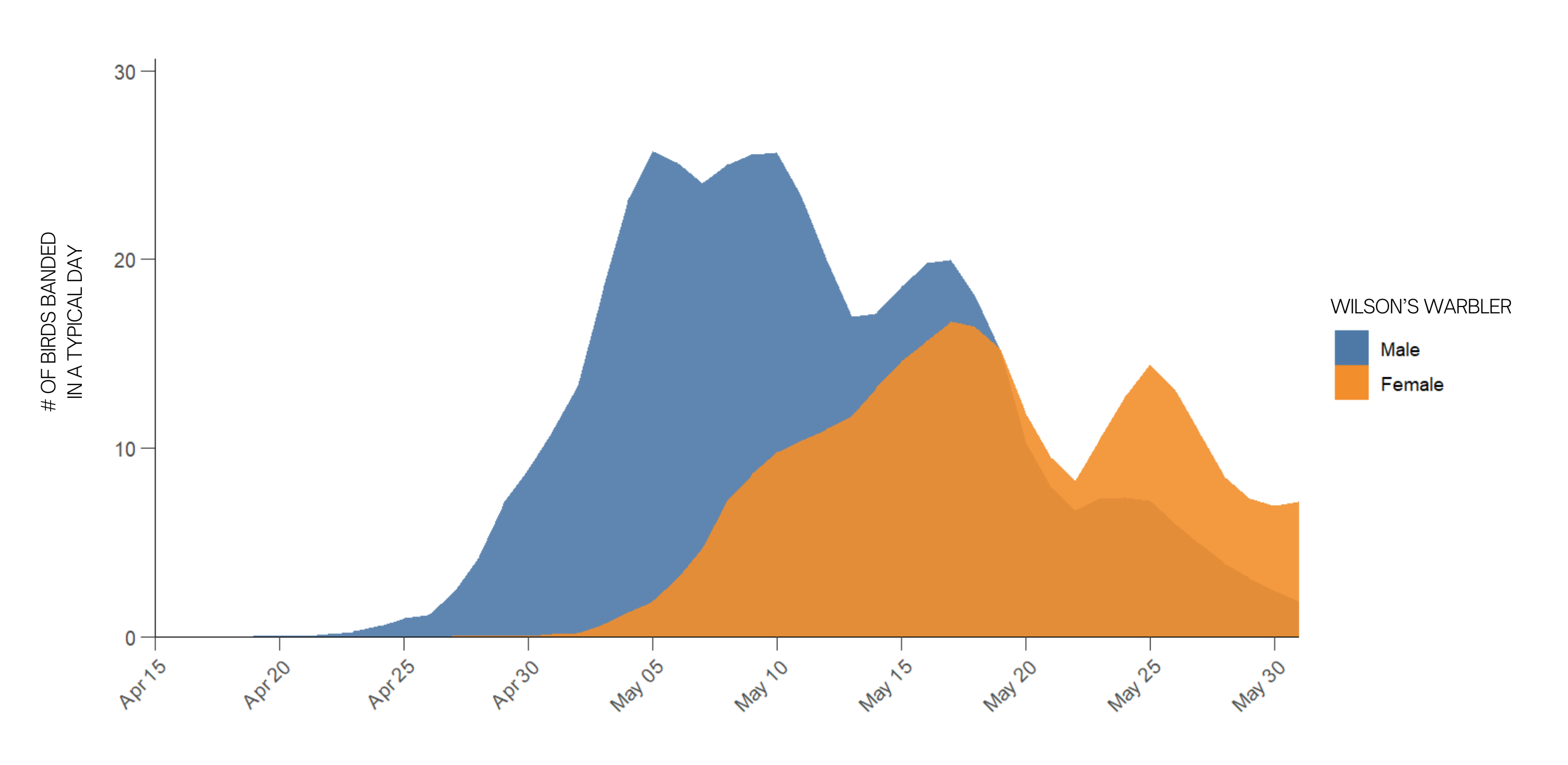
Wilson’s Warblers arrive at Iona in two pulses, with males arriving before the females.
Many studies are also finding that climate change and shifting timing in resources are altering migration patterns, often resulting in mismatches between bird arrival and peak food availability. Although not analyzed for this project, it’s also likely that the waves are influenced by the age of the birds as well.
A different rhythm in fall
In the fall, birds are no longer racing to breed and take advantage of increasing food in the north. Instead, adults and newly fledged (independent) young move south on instinct as temperatures dip, days shorten, and food dwindles.
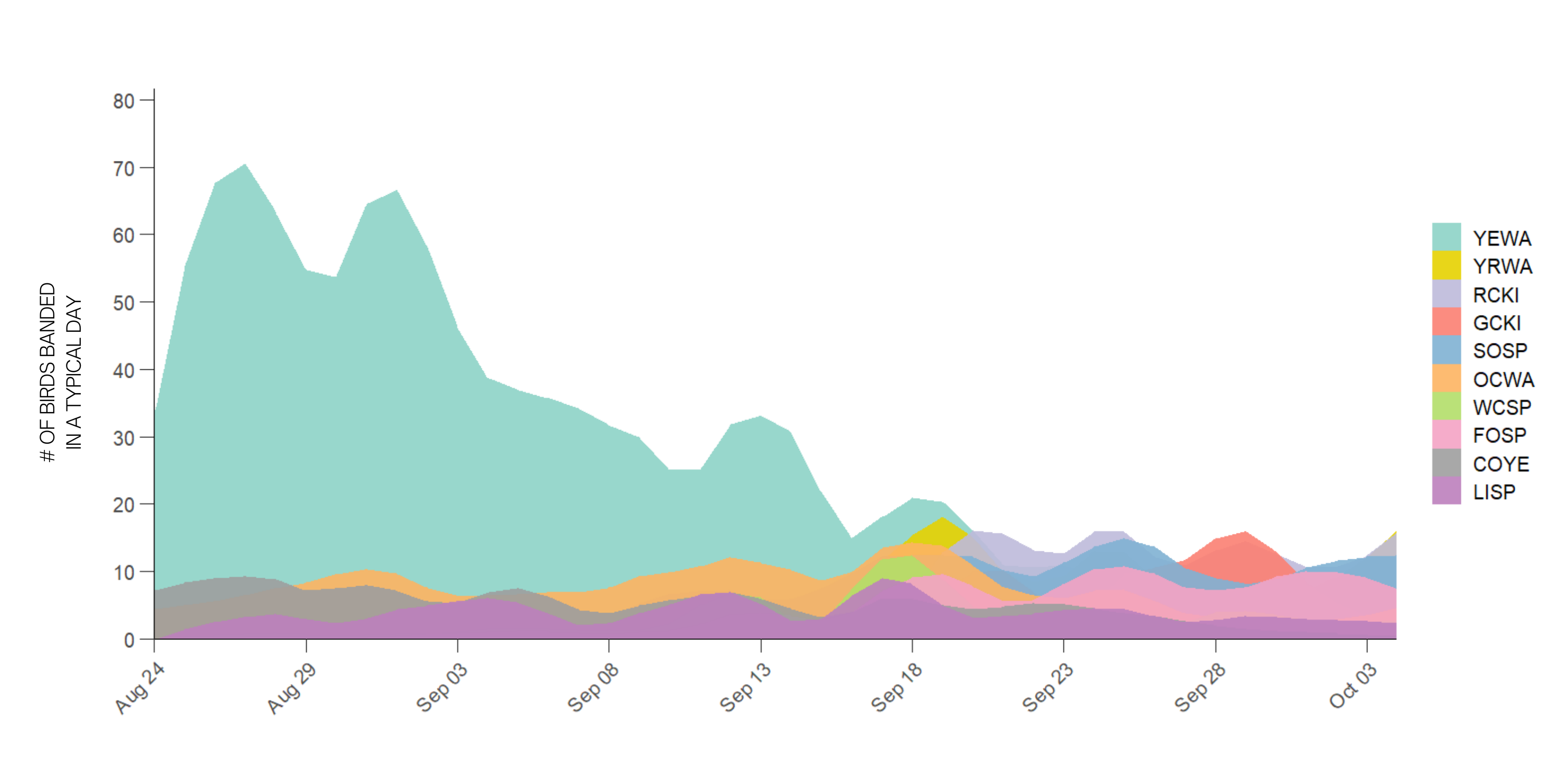
The 10 most frequently banded species at the IIBO are different in the fall than in the spring, with many more sparrows coming through. Extensive literature shows that migration routes and timing can vary between spring and fall seasons. At Iona Island, Yellow Warblers are among the first to depart and extremely abundant, with 4,747 banded over the 2015-2025 fall monitoring seasons.
Fall migration patterns tend to be more spread out and variable. This is likely in part because birds within a species don’t all nest at the same time and the young birds (who are migrating for the first time) don’t necessarily leave with the adults or move at the same pace.
About the data behind the graph
These graphs and summaries are based on data of newly banded birds at the Iona Island Bird Observatory from 2015 through 2025. Recaptures were excluded so each data point reflects a unique individual. Spring monitoring was defined as April 15th to May 31st, and fall as August 24th to October 4th.
Banding data was sourced primarily from submissions to the Bird Banding Office (BBO) under Environment and Climate Change Canada. Data was analyzed and visualized in RStudio 2024.12.1. Species 4-letter codes were standardized to species level (e.g. UWCS, GWCS, and PSWS changed to WCSP) and the top 10 most frequently banded birds identified for each season.
Daily counts of banded birds were standardized by the daily net-hours and scaled to 84 net-hours, representing a banding day with 14 nets open for 6 hours each. Data was then pooled across all years. This approach highlights migration patterns (when individuals arrive and how that builds over time) rather than differences in effort due to bad weather or limited staffing. Curves were smoothed with LOESS (α = 0.22) to reduce noise and increase public-viewing accessibility. The resulting curves show the typical timing and relative abundance of each species at the station, rather than exact counts from a given single day or year.
Written by Paula Gomez Villalba | Jan 2026
Posted: February 24, 2026
Invasive Plant Resources
While native plants support insects and provide food and shelter for millions of birds, invasive species put pressure on local ecosystems and reduce biodiversity. Many invasive plants were introduced (either intentionally or unintentionally) by people. This page brings together resources from organizations and community groups working to better understand invasive species and reduce their spread.
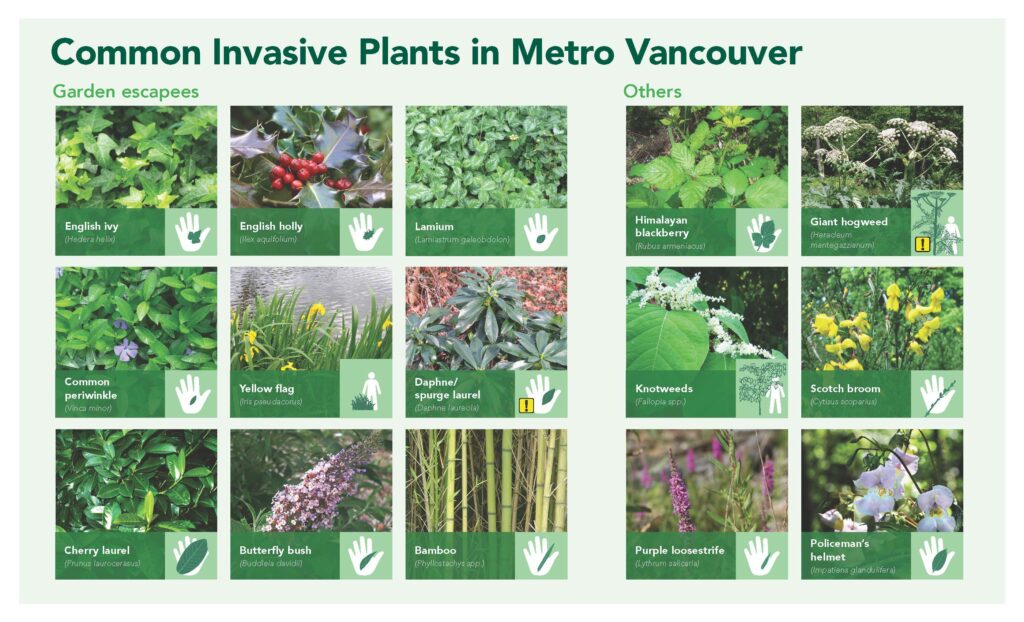
From Metro Vancouver Regional Parks’ brochure, Help Stop the Spread of Invasive Species:
What is an invasive plant?
It’s a plant species that isn’t native to our region and also tends to be super efficient at growing and spreading. Because it didn’t evolve here, it has no natural controls (predators, diseases, etc.) to keep it in check.
Why are invasive plants a problem?
There are lots of reasons, but here are a few:
• They affect wildlife by degrading habitat
• They can alter water flow and lead to erosion
• Some contain substances that are toxic to people and animals
• Some can increase the risk of wildfires”
A threat to traditional practices
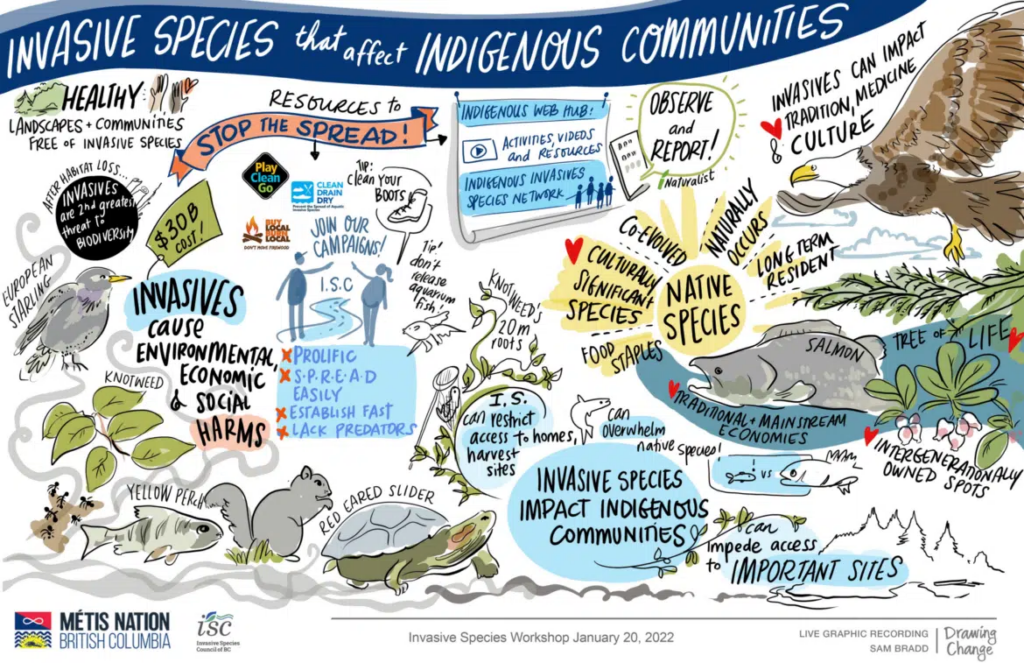
Invasive species can also threaten Indigenous food systems, medicines, and cultural practices by displacing the native plants that people have cared for and relied on for generations.
The Invasive Species Council of BC helps groups work together to stop invasive species from spreading across the province. Their Indigenous Connections page shares how invasive species affect traditional practices and how Indigenous communities continue to guide land care across the province.
From removal to relationship
Much of the plant biodiversity around the Iona Island Bird Observatory is supported by Metro Vancouver Regional Parks staff through invasive pulls, native species planting, and ongoing maintenance. You can take a walk in the park during the spring or fall migration seasons to learn about the nearby native plants. Loop trail posters created as part of Stories in Flight share their connections to birds and people.
Across Metro Vancouver, there are also many hands-on opportunities to get involved in caring for local parks and natural areas, including through:
- The Metro Vancouver Ecological Restoration Team
- Everett Crowley Park Committee’s Stewardship sessions
- Stanley Park Ecology Society’s Dedicated Invasive Removal Team (DIRT) and EcoStewards programs
- Burns Bog Conservation Society’s invasive species removals
- Jericho Stewardship Group’s Stewardship Events
- Burnaby Lake Park Association’s Weedbusters
Some organizations are finding ways to transform invasive plant removal into opportunities for art and community. For example, Free the Fern and the Everett Crowley Park Committee have partnered in the past to host Weeding and Weaving workshops using invasive English ivy.
Resources compiled by Paula Gomez Villalba | Jan 2026
Posted: February 24, 2026